
Your customers look for providers on Google. Sometimes they ask ChatGPT for recommendations. That raises two questions for your business. What do you need to do to be found, and which work is worth paying for separately?
Some of the work is the same. Search systems need to be able to reach your site. Your pages need to explain your services clearly and show evidence of your experience. The differences lie in how each platform chooses sources and how you measure results.
Here’s how to decide which pages to work on, what the platforms require, and what we saw in our own tests. We also share the baseline for the Pe Prima Pagină website relaunch.
Where can customers find you in search and AI answers?
Google’s first page is one of several places a customer can discover your business.
An assistant might cite your business as a source without recommending it as a provider. It might also recommend you to someone who never clicks through. Track appearances and visits separately so you can see both.
How to rank on Google for searches that matter
A specific page ranks for a search query or a group of related queries. Start by deciding which ones are worth competing for.
1. Start with what potential customers search for
Pick the products or services that matter to your business and list the questions customers ask before they buy. Work out what they need at that moment. Are they looking for an explanation, a comparison, or a provider?
A high-volume search can attract people who are nowhere near a decision. A specific question may have low search volume and still matter a great deal for the service you offer.
2. Check what kind of page answers the query
Look at what already ranks. Are the results service pages, product categories, guides, or comparisons?
For a furniture retailer, “extendable dining tables” calls for a category page where customers can browse products. “What size dining table fits in a small living room?” calls for a guide with explanations and examples. Each page helps with a different decision.
3. Give readers the information they need to decide
A product page should cover dimensions, materials, available finishes, and delivery and assembly terms. Photos of the table both extended and closed show how it works in practice.
A guide to choosing a table should explain how much floor space it takes up and how much clearance to leave for chairs and walking around it. Measurements, photos from real rooms, and advice from a specialist help readers choose for their own home.
Google’s guidance on helpful content recommends writing for people and drawing on firsthand experience and original contributions.
4. Help people find the page and track its performance
Check that crawlers can access the page and that Google has indexed it. Link it to other relevant pages on your site. Internal links help visitors find useful information and help Google discover pages and understand how they relate. Then track which searches the page appears for and how many clicks it gets.
If the page shows up often on Google and gets few clicks, check which queries trigger it and where it ranks. Look at the title and description people see in search. Do they give someone a reason to visit?
If people reach the page but few buy, check whether they have enough information to choose the product. Look at the price, shipping costs, and how easy it is to place an order. That’s part of conversion rate optimization, which helps more visitors place an order or make an inquiry.
Progress depends on the competition, the state of the site, and the changes you make. Watch what moves and use what you learn to decide what to improve next.
What makes a page eligible for Google’s AI answers?
In its documentation on AI features, Google says a page must be indexed and eligible to appear with a search snippet. It requires no AI-specific files or markup.
To build an answer, Google’s systems can run several searches on related topics. A page may then be selected for one relevant detail, even if it doesn’t rank near the top for the original query.
The same SEO fundamentals apply. Google needs to be able to find, crawl, and index useful pages. Meeting those conditions makes a page eligible for selection. Whether Google cites it depends on the answer.
Where do AI assistants get their information?
Assistants can draw on what the model learned during training or search the web. Which sources they can access, and how they choose among them, varies by product.
For ChatGPT, OpenAI recommends allowing OAI-SearchBot to access your site and checking for blocks at the hosting level. OpenAI’s crawler documentation has the details.
Information published elsewhere also matters. An assistant might consult your site, a directory of providers, a review, or a news article. We saw all four kinds of source in our tests.
Here’s what to check on your website and across the sources you control.
Use tables and lists when they make information easier to follow. Formatting alone can’t guarantee a citation.
What do AI assistants cite when they recommend a marketing agency?
On November 8, 2026, we tested questions a prospective client might ask when choosing a marketing agency. We ran the ChatGPT tests in a Temporary Chat without personalization. The table gives the test questions in English.
Pages dedicated to the service in the question appeared alongside directories, rankings, and press coverage. Two of the Agerpres items cited were press releases paid for by their issuers and published in the OTS section. Those placements were used as sources too.
We also tried Google while signed out, using “ce imi recomanzi cand alegi o agentie SEO” (“What advice would you give me on choosing an SEO agency?”). The AI summary cited our article on choosing an SEO agency. It was still the version on our old site, which hadn’t been updated in years.
A page can be cited even if it hasn’t been updated recently. Our reading is that the article was picked because it answers a question close to the one we asked Google. The title promises advice on choosing an SEO agency, and the article delivers on it.
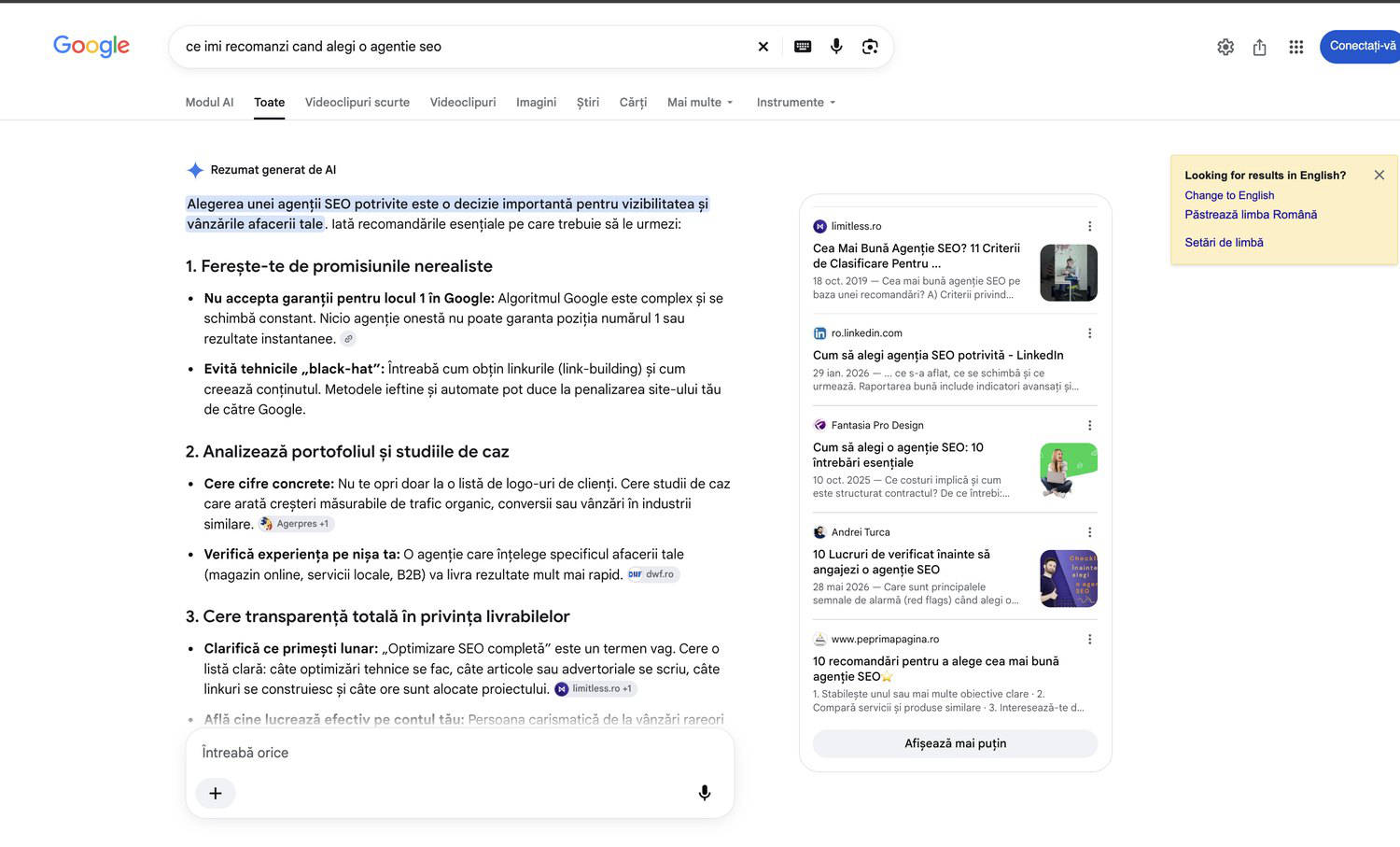
The tests show what the platforms returned at the time. To see how that changes, we’ll repeat the questions and save the answers and their sources.
How we applied this to our own website
We relaunched the Pe Prima Pagină website in November 2026. The agency had grown through referrals while the site fell behind. Its content no longer reflected the services we offered or the experience we had gained.
The platform also ran on a very old version of PHP. We found only one hosting provider in Romania that still supported it, and that support was due to run through 2027.
We started with the questions someone might ask before hiring us. Which service do I need? What would working with the agency involve? What can I verify before asking for a proposal?
We reorganized the service pages and rewrote much of the site. We added anonymized case studies and explained how we approach projects. We linked articles to the relevant services and examples.
Our baseline before the relaunch
Before the update, the general Search Console performance report showed only a handful of clicks. The separate report for AI features already showed impressions.
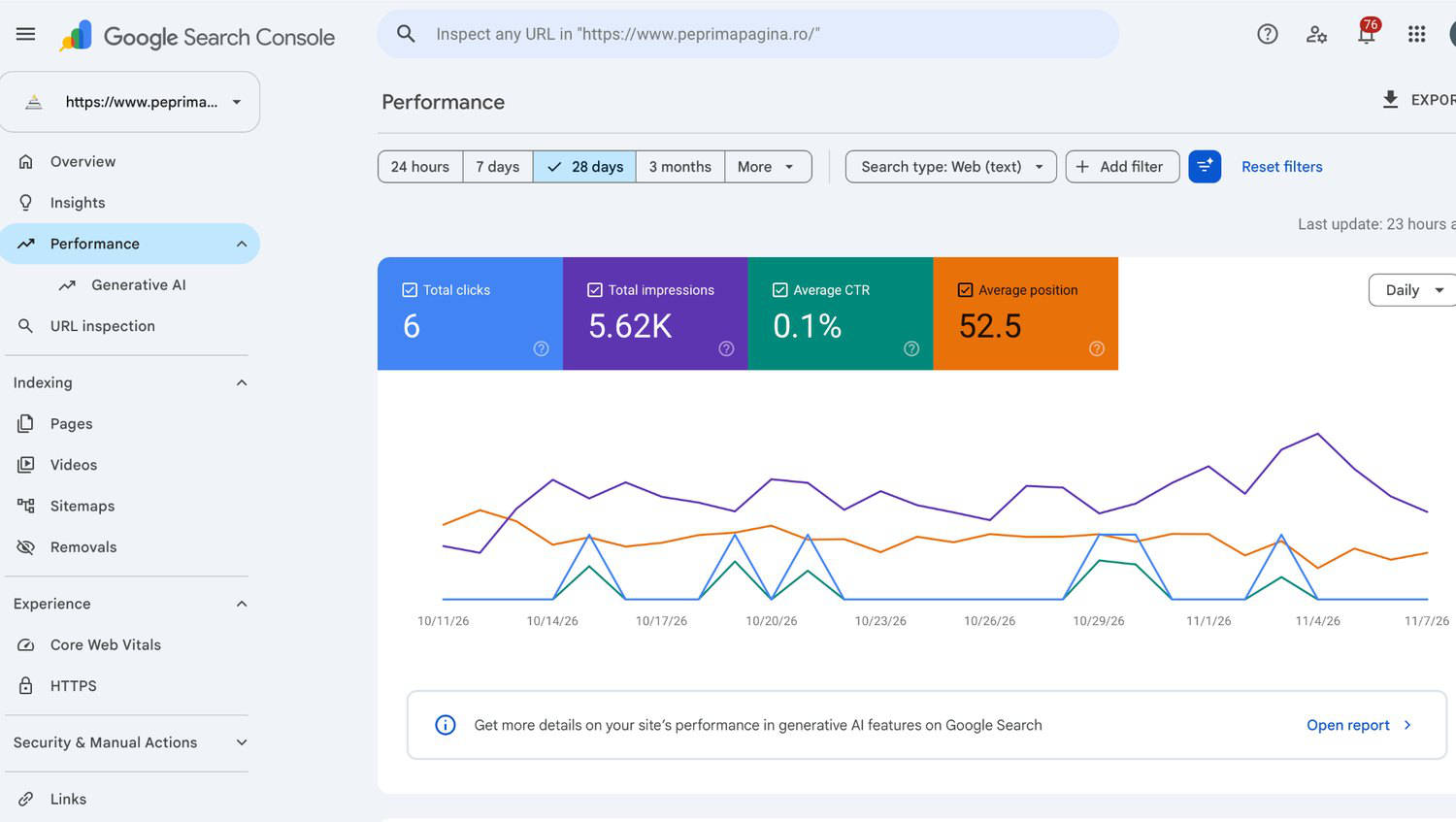
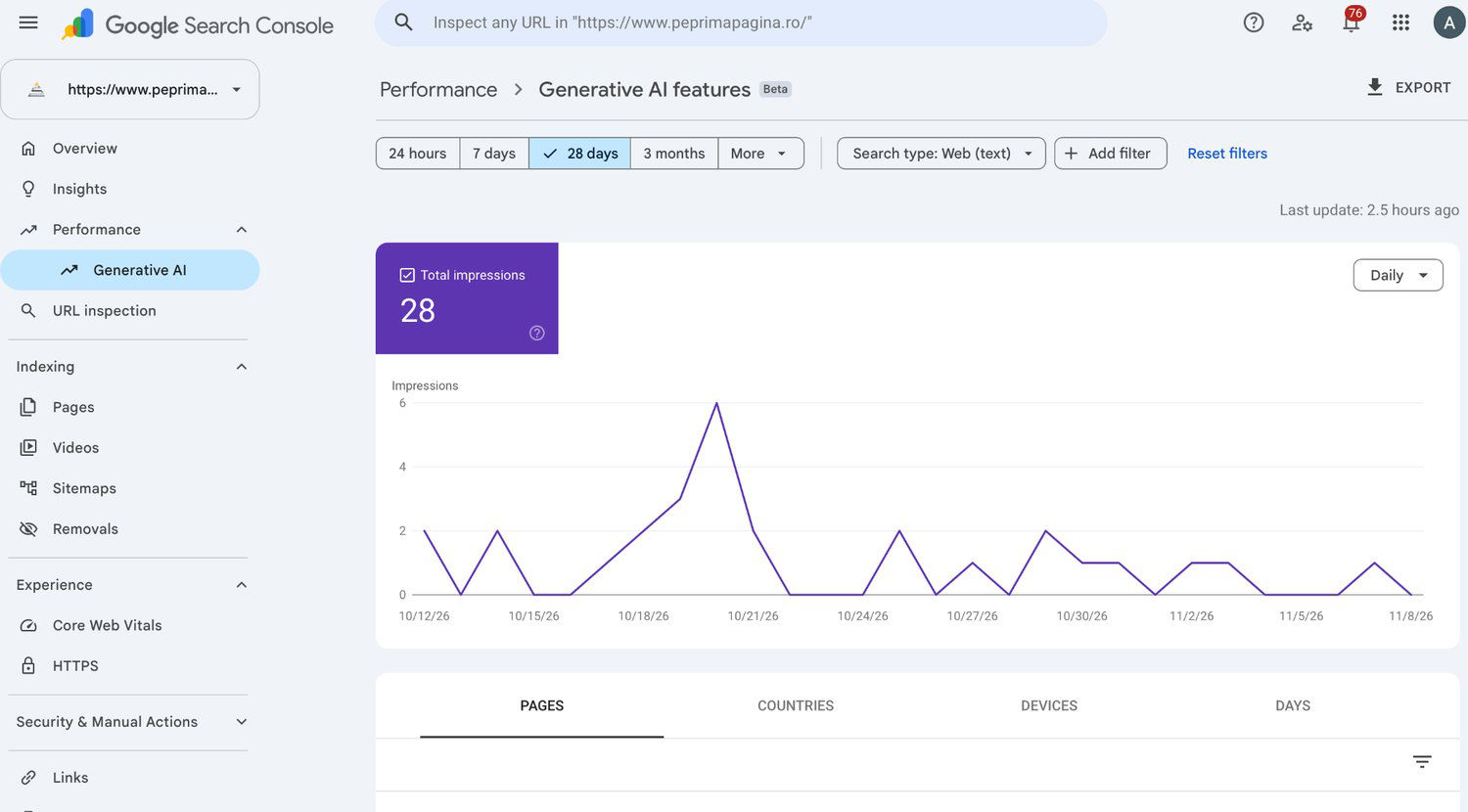
The site was already appearing in some AI answers, including the citation of our guide to choosing an SEO agency. Recorded traffic was still low.
What we’ll track
After the launch, we’ll track page visibility, clicks, and appearances in AI answers. We’ll share periodic updates on the results.
Can you start working on AI visibility right away?
You can start on day one. What you do first depends on what the site needs.
In each case, the on-site work for Google and AI assistants can happen on the same pages. Our SEO and generative engine optimization (GEO) service pages explain how we handle each situation.
How to track visibility in Google and AI recommendations
Use Search Console to track Google queries, pages, and clicks. The AI features report covers impressions in AI Overviews and AI Mode.
Analytics can track visits from assistants when it can identify the source. OpenAI says links in ChatGPT search include the parameter utm_source=chatgpt.com.
A mention without a site visit won’t show up as traffic in Analytics. Check periodically, by hand or with a tracking tool, whether your business appears in AI answers and which sources get cited. The results reflect the questions you tested and the times you ran them.
Track incoming inquiries and what happens to them. Asking “How did you hear about us?” adds information your analytics tools may miss.
Where to start
Pick a service that matters to your business and see how customers search for it. Review the page that describes it and the evidence you provide. Then try relevant questions on Google and in AI assistants.
Use what you find to decide which information to add, which technical issues to fix, and where you need an outside source to cover your business.
Our SEO and AI visibility service pages explain how we work. Our case studies show the approach and results of selected projects.