
If you’re hiring an SEO agency for the first time, it’s hard to know what to ask. If you’ve hired one before and the work fell short, it’s hard to know who to trust. And if you bring a checklist from ChatGPT, you may end up asking for the same metrics your last agency used to report.
SEO proposals are hard to compare. One lists articles. Another counts backlinks. A third quotes hours or lists the number of keywords it will track. Prices for similar projects can vary severalfold. Results take time, so the decision often comes down to how confident the person presenting the proposal sounds.
These tips take you from deciding what your site should deliver to reviewing your first few months with an agency.
Set your goal
1. What would a good result look like for your business?
Before you ask for proposals, write down what you want to change. You might want more inquiries about a particular service, more orders in higher-margin categories, or more calls from your service area. Rankings and traffic help people find you. The business result depends on what they do once they arrive. If you already get plenty of visitors and few requests for a quote, the page itself may need work. That’s where conversion rate optimization can help.
If this is your first time hiring an agency, you can start with what you sell, who buys it, and which part of the business you want to grow.
If a previous agency fell short, check what it was tracking. It may have measured rankings for dozens of keywords that had little to do with the inquiries you wanted.
If you already know what to ask for, consider where those requirements came from. A monthly backlink quota or an increase in a score such as Domain Authority (DA) or Domain Rating (DR) often carries over from past agency reports. Google doesn’t use those scores to rank pages. Ask the agency what it tracks to judge progress on your site.
Before you request proposals
2. What should the agency know about your business?
A good proposal starts with an understanding of your business. Have these details ready.
That last point can change the quote considerably. If nobody is available to implement the recommendations, you’ll need to budget separately for a developer.
In its guide to hiring an SEO professional, Google recommends bringing someone in early. Ideally, do it before a redesign or a new site launch, when the site structure can be built with search in mind.
If you used an AI assistant to draft your questions, keep the ones you understand and know how to follow up on. Working through a long checklist can take up the meeting without bringing you any closer to a decision.
How to read an SEO proposal
3. Is the proposal based on your website?
A standard package typically lists the same deliverables for every business: a set number of articles, backlinks, and tracked keywords. A plan built for your business explains what the agency found on your site and which issues it would address first.
An article count tells you how much the agency will publish. A 2025 Ahrefs study found that only 1.74% of new pages reached Google’s top 10 within their first year.
Ask what the agency would do on your site in the first three months and how it decided on those priorities. Look for specific pages, categories, or services, with a reason for starting there. A list of generic activities could apply to any business.
Some proposals include a fixed number of sponsored articles per month and a minimum authority score for the publications. Who reads those articles? Do they show up on Google for searches relevant to your business? Does the publication reach people who care about the subject?
A sponsored article can stay online for years without showing up for relevant searches. Google can even drop it from its index while the publisher keeps it live. A promise of permanent placement tells you little about the exposure you’re paying for.
If the agency’s entire case rests on the publisher’s authority score and the backlink, ask what else the placement achieves. You could pay every month for articles that reach few readers and exist mainly to influence rankings. Google treats links bought for that purpose as link spam. Paid links should be labeled appropriately, preferably with rel="sponsored".
Timing matters, too. A sponsored article sends readers to your site. Make sure your service pages, case studies, and About page already show who you are and what you do well.
You can often get more out of regularly pitching something genuinely new to journalists, such as data from your own work or a market analysis they can cite. Earning that coverage takes more work, and a publisher quoting you as a source tells readers more about your business than a paid article does.
A July 2025 Muck Rack study found that more than 95% of the links AI assistants cited came from non-paid sources, most of them earned media such as news coverage. Journalistic coverage accounted for about 27% of cited links. Digital PR can help you earn that kind of coverage. You pay for the work of securing coverage. The publication decides whether to run it. We cover other ways SEO spending can go astray in 9 SEO mistakes that drain your budget without bringing in sales.
4. Do you need everything in the proposal?
A proposal with more services can look like better value. Social media, content, advertising, and design changes can all have a place if they help you reach the goal you set at the start. For each item, ask what problem it solves and what would happen if you left it out.
Apply the same test to visibility in AI answers. Google draws on indexed pages for its AI answers, so SEO is the foundation. SEO also helps with assistants such as ChatGPT and Perplexity, where coverage of your business elsewhere on the web matters too. If AI visibility is quoted separately, ask what the agency can measure directly and what it can only estimate. We explain how the two kinds of visibility connect in How to rank on Google’s first page and appear in AI answers.
5. What will SEO cost in total?
An agency needs to look at your site before it can quote a fair monthly retainer. The cost depends on several factors.
A fixed price offered before anyone looks at the site is usually the price of a standard package. Rates can vary considerably depending on the time allowed for analysis, research, and implementation. If two proposals include articles, ask who chooses the topics, what they need from you, and who checks the final drafts. An agency can hit a monthly article quota with very little understanding of your business. Check whether the fee covers technical implementation and paid placements on other sites.
6. How do you compare SEO proposals?
Ask every agency the same questions. You can fill in this worksheet for two or three proposals during the calls.
Download the comparison sheetIf a row is still blank, get the answer before you sign.
7. Are the case studies relevant to your business?
A recognizable logo tells you who hired the agency. To see what it could do for you, ask for a project with a similar starting point and budget. Find out what the agency did and what changed. Large brands bring greater name recognition and different budgets. An agency may also have worked with that brand for only a few months or on one part of the site.
A case study should tell you where the client started, what the agency did, how long the work took, and what it achieved. Be wary of promises made before any analysis, such as guaranteed rankings, double the traffic, or results in 30 days.
If the case study shows a rise in traffic, ask which pages drew visitors and which searches brought them in. Find out what data the agency has on quote requests or orders from Google. For a service business, look at inquiries for the specific service the agency worked on.
When you discuss what to expect for your site, ask what the forecasts are based on. What opportunities did the agency find? What would it do about them, and what would it need from you? Agree on what you’ll measure and when you’ll review progress.
What to ask in the agency meeting
8. Who will work on your site, and how will they get to know your business?
The person who presents the proposal may have a different role from the people doing the work. Ask who sets the strategy, who checks the implementation, and who answers your questions. A larger agency might assign several specialists. A small agency might keep the same two or three people on the project throughout. Either can work if you know who is responsible for what.
Google’s hiring guide suggests several questions. Three are worth asking any agency.
For technical or B2B services, ask how the team researches the subject. Good industrial product copy uses terms your customers recognize and answers the questions they actually ask. Engineers and sales staff are often the best source for both. Ask how the agency will learn your business and who checks the facts before publication. For one industrial equipment distributor, we drew on technical standards and projects the company had completed. We explain the approach and results in our case study on search visibility in a specialized industrial market.
One question people rarely think to ask is “Do you work with any of my direct competitors?” Some agencies serve several clients in the same industry on different projects or services. Others take one client per niche or charge for exclusivity. Find out how the policy applies to you. The agency will have access to information about your results, priorities, and plans for growth. Ask how it handles competing clients, what the contract says about confidentiality, and what any exclusivity clause would cover.
What to check before you sign
9. What do you keep when the engagement ends?
Register the website domain in your company’s name and keep Google Analytics, Search Console, and Google Business Profile under its control. Give the agency the access it needs to do the work. Put your rights to the materials it creates in writing so you can keep using them when the engagement ends.
Agree up front on what the agency will hand over, including materials, reports, and a record of recommended and implemented changes. Decide who will revoke agency access and disconnect any reporting tools.
Some data may sit in tools the agency owns. Agree on what it will export for you, what it will delete, and what it will keep, for what purpose and for how long. Set terms for confidentiality and any future use of information about your business.
Check the minimum term, notice period, and termination conditions. A commitment of several months can make sense because SEO takes time. Agree on how you’ll assess progress and how you can exit if the engagement falls short of what you agreed.
If a previous engagement disappointed you, use that experience to settle these details early. Switching agencies is easier when you have access to the accounts, the data, and a record of the work.
How to judge the first few months
10. What should an SEO report tell you?
An SEO report should explain what the agency did, which results are starting to come through, and what it plans to do next. More impressions can be an early sign of progress. It’s worth checking what drove the increase. Our old site, built around 2016, offers an example. It had gone several years without changes, so the reported impressions couldn’t be attributed to recent optimization.
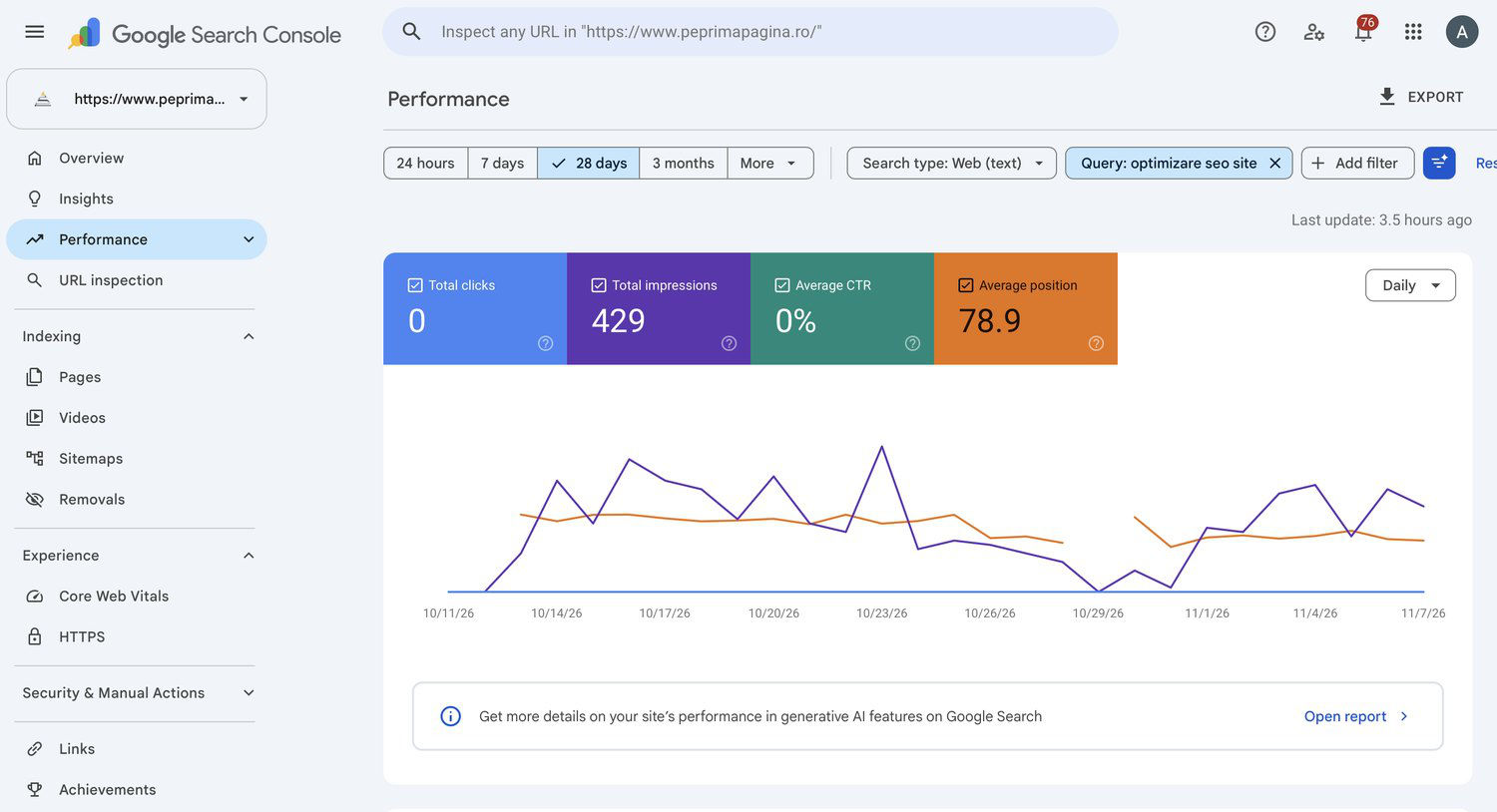
We took the screenshots below on November 8, 2026, before replacing the old site. Search Console reported 429 impressions in the previous 28 days for “optimizare seo site” (website SEO optimization). Estimated monthly search volume was about 210, so reported impressions were more than twice the estimated searches. The average position was 79, with zero clicks.
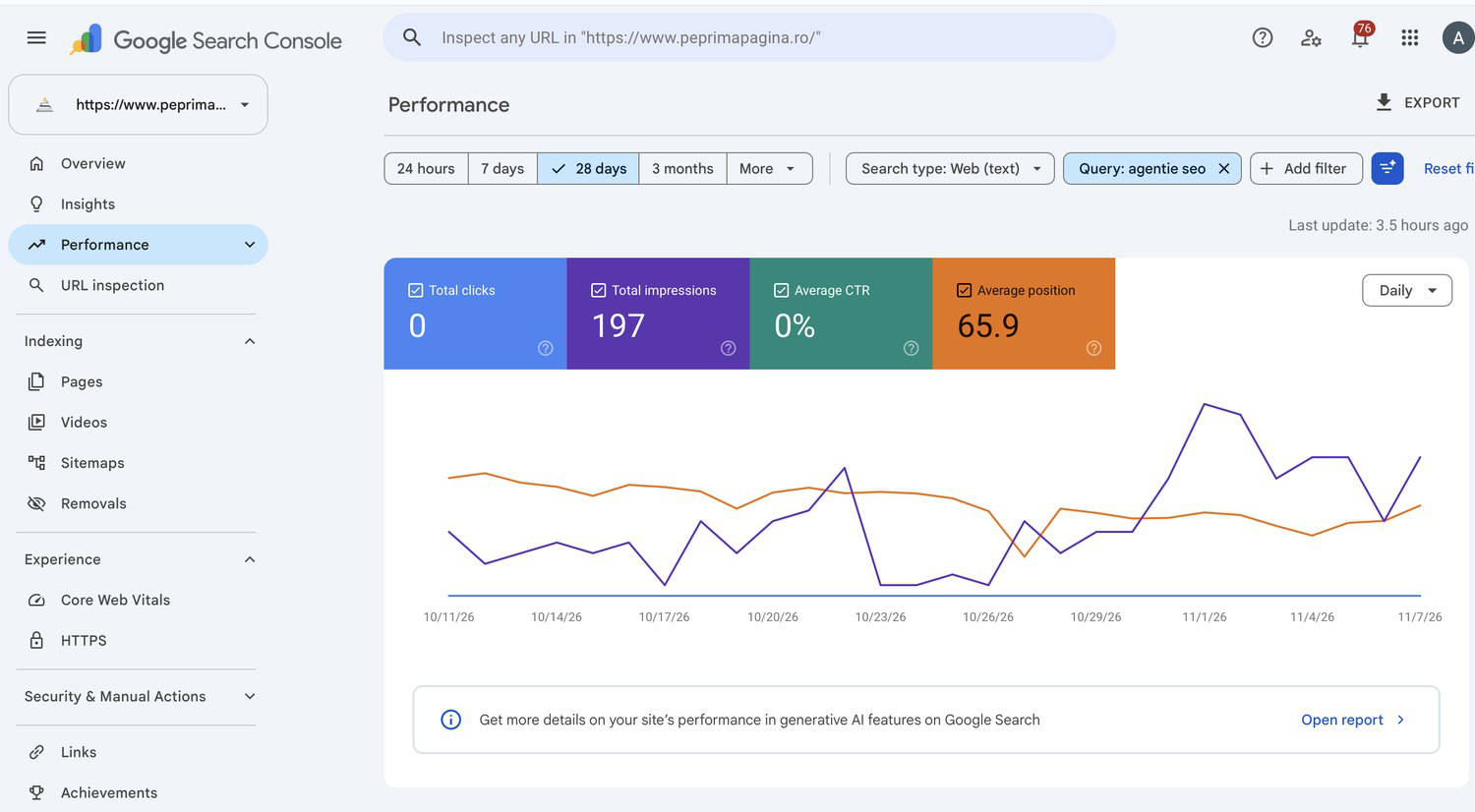
For “agentie seo” (SEO agency), Search Console reported 197 impressions in the same period. The average position was 66, also with zero clicks.
Automated rank checks are one possible explanation. SEO tools look for sites deep in the results, where few people venture. Some impressions may therefore come from rank tracking. Search volumes are estimates, so the gap alone can’t establish the cause. Combined with the low rankings and lack of clicks, it’s a reason to look more closely.
Agree up front on what the report will track and how you’ll judge progress. Impressions for relevant searches and better rankings can show that your pages are becoming easier to find. Track clicks alongside them, including which pages receive those clicks and what inquiries or sales come from organic search. The report should explain what was implemented, how results changed, and what happens next.
How soon can you expect results? Google’s SEO Starter Guide says some changes can take effect within hours, while others take several months. In practice, sustained gains in visibility usually take a few months of work. Timing depends on the state of the site, the competition, the changes you implement, and seasonality. Ask what signs of progress the agency will look for early on and when you’ll review priorities together.
Greater visibility can take time to translate into inquiries. A result that moves from page ten to page five has climbed, but it’s still well beyond the results most people look at. Early on, it can help to focus on one service, one product, or a group of searches with the same intent. That makes it easier to see what the changes achieved and decide when to expand the project. Our case study on a medical aesthetics clinic follows an engagement that began in 2018.
If progress feels slow, start with what you can verify. Look at what’s been implemented, how rankings, clicks, and inquiries have changed, and how the agency explains the results. Compare the same period last year if you have the data. Review the evidence together and agree on what needs adjusting.
How to make the final choice
You should now have a shorter list and know why each proposal made the cut. For every option, you can name the problem the agency will solve, what it will cost, who will do the work, what the reports will show, and what you’ll keep. The right agency can answer those questions clearly before you sign.
Our SEO services page explains how we work. Our case studies show the projects, the changes we made, and the results we tracked.