
Updated in November 2026
On LinkedIn, you can read almost every day that SEO is dead and that customers now make all their decisions in ChatGPT. If you’re paying for SEO and your reports show fewer clicks for some searches, it’s reasonable to ask whether the investment still makes sense.
We’ve heard that SEO was dead at least four times since we started doing it in 2014. First came voice search. Everywhere you looked, people said half of all searches would be voice searches by 2020. The original prediction was about China and grouped voice searches with image searches. Then video took off, and the argument was that people would watch clips instead of reading. When TikTok reached Romania, we heard that a business without a presence there might as well not exist. Now it’s AI’s turn.
Each time, what was worth paying for in SEO changed. People kept searching on Google. If they already search there for what you sell, keep your SEO budget. Invest first in the pages customers use to choose a product or provider. If you need to cut back, start with articles that attract visits for general questions unrelated to your offer.
Where do customers look for you today?
Google is still the main channel. According to Eurostat, 17.8% of people in Romania aged 16 to 74 used generative AI tools for any purpose in the three months before the 2025 survey. That was the lowest share in the EU. The EU average was 32.7%.
Website referrals show a similar gap. Statcounter compares visits sent by search engines, social networks, and AI assistants to a sample of sites. In Romania in June 2026, almost eight in ten of those visits came from search engines. AI assistants sent fewer than two in a thousand. These figures count visits to websites. Some people read the answer in the chat and stop there.
We see a similar pattern with our clients. At a medical aesthetics clinic we work with, more than seven in ten online sales came from visitors referred by Google during its November 1–17, 2026 Black Friday promotion. Almost half of all online sales came from ads managed by another specialist. We wrote some of the ad copy. A quarter came from organic search, even though we hadn’t optimized the Black Friday offers specifically for search. ChatGPT accounted for four in a thousand online sales.
If Google already brings you inquiries, keep investing in the pages that generate them. For ChatGPT, start with the questions customers ask before buying. Which supplier delivers to their city? Which product will fit their space? Then look at the businesses and sources the assistant points to. That can show you what information your site is missing.
Google’s documentation says that a page must be indexed and eligible to appear with a snippet in regular search results before it can be included as a source in AI Overviews or AI Mode. We explain how these fit together in How to Rank on Google’s First Page and Appear in AI Answers.
Why are Google clicks falling?
People still search on Google. What they see on the results page has changed. AI Mode has been available in Romania and in Romanian since October 2025. For many searches, Google also shows an AI-generated summary above the results.
When people get the answer on the results page, some leave without visiting a website. A Pew Research Center study tracked the browsing activity of about 900 U.S. adults in March 2025. They clicked a traditional result on 8% of visits to Google results pages with an AI summary. On pages without one, the figure was 15%.
We also track search volume for our own services. For the Romanian query “agenție seo” (SEO agency), estimated search volume fell 57% between November 2025 and November 2026. Google now shows an AI Overview above the results for that query. The estimate alone can’t tell us why the volume fell. Other industries may see a different pattern.
Which searches are sending less traffic from Google?
AI Overviews tend to show up for questions. In the same Pew study, 8% of searches that used one or two words triggered an AI summary. The share rose to 53% for searches of ten words or more.
Pages that answer general questions have the most to lose. A definition or a basic explanation often fits in a few lines. That may be all the person searching needs.
Searches closer to a purchase are less affected. Think of a product name, a service in a particular city, or the name of a company. An AI summary can explain what a magnetic lighting track is. To choose one for your kitchen, you need dimensions, mounting options, and a list of compatible fixtures. A category page or buying guide can give you those details.
For an online lighting store whose SEO and AI visibility we work on, Google cites the store’s buying guides in AI-generated answers. People who are close to buying can click through for the details they need. The store’s case study explains how we built that visibility.
Do fewer clicks mean fewer customers?
HubSpot, the U.S. company behind the term “inbound marketing,” spent years building much of its visibility through blog articles. The idea was to attract customers with useful content. At its peak, the blog drew more than 20 million organic visits a month. Traffic fell sharply as AI answers became more common and Google updated its algorithms. In January 2025, Surfer estimated a year-over-year decline of about 81%. HubSpot’s chief marketing officer, Kipp Bodnar, later confirmed that the blog had lost about 80% of its organic traffic, according to Search Engine Journal.
If SEO were dead, you might expect HubSpot to be among the first to feel it in sales. Its revenue grew 19% year over year in the second quarter of 2025. The type of traffic it lost helps explain why. Visits from general questions fell. Searches by people looking to buy continued to drive conversions, as HubSpot itself explained.
At the August 6, 2025 earnings call for that quarter, CEO Yamini Rangan told investors that only 10% of HubSpot’s prospects now came from blog traffic. The remainder came from channels built with the resources of a global company, including ten YouTube channels, social media, podcasts, and newsletters.
A Romanian business can use the same diagnostic. If organic traffic is down, start with the pages that lost clicks. Losing visits to definition articles has different consequences from losing visits to service pages. Before cutting your budget, check whether the pages that used to generate quote requests are still bringing in as many.
Where should you spend your SEO budget now?
Spend less on definition articles and on packages that commission large batches of articles based on search volume. Those are often the pages losing the most clicks. We explain why they rarely lead to sales in 9 SEO Mistakes That Drain Your Budget Without Bringing in Sales.
Put more of the budget into these areas.
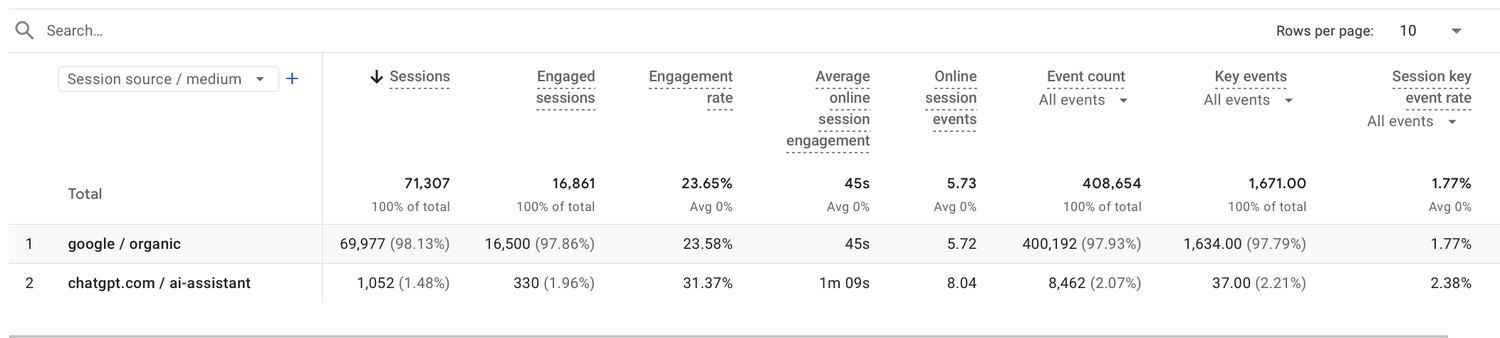
AI assistants send few visits, but some of those visitors are ready to buy. At the same clinic, from November 1 to 17, visits from ChatGPT led to a sale 34% more often than visits from organic Google search. We also work on the clinic’s visibility in AI answers. The case study shows the results.
When should something else come before SEO?
SEO works with demand that already exists. Two situations can change what you invest in first.
Where do you start?
Ask the agency or specialist who handles your SEO to run the analysis. Get answers to three questions for the same period this year and last year.
If the losses are concentrated in general articles and inquiries are steady, move the budget toward pages that drive sales. If inquiries are down too, prioritize service pages and technical issues.
Your part is the one you know best. How many inquiries turned into customers, and what margin did those sales bring in? Compare the full cost of SEO, including agency and developer fees, with the sales that came from relevant inquiries over at least a few months. Traffic can fall while SEO remains profitable. A steady flow of inquiries still has to justify what you spend.
If you’re choosing an agency, 10 Tips for Choosing the Right SEO Agency for Your Business can help you compare proposals.